The True Cost of Cloud GPUs: What Your CFO Needs to Know Before Signing That Commitment
Cloud GPU pricing looks aggressive on paper. But hourly rates hide commitment traps, counterparty risk, and debt-funded subsidies that change the math entirely. Here is what your finance team should model before signing.


The GPU cloud market has a pricing problem. It isn't the one most people think.
Walk into any IT planning meeting right now and someone will pull up a cloud provider's pricing page, point to an hourly rate, multiply it by the hours they need, and declare the project budget "done." It's clean. It's simple. And it's almost certainly wrong.
The real cost of cloud GPU compute isn't on the pricing page. It's buried in commitment structures, hidden in adjacent service fees, and most critically, underwritten by a financial model that may not survive the next market correction.
Understanding how cloud GPU pricing actually works isn't just a procurement exercise. It's a risk management decision. Here's what your finance team should be modeling before signing anything.
Hourly Rates Are the Wrong Unit of Comparison
Cloud providers publish GPU pricing in hourly increments. It's a brilliant framing choice, because small numbers feel approachable. An H100 at $6/hour sounds reasonable.
But nobody runs a training job for one hour.
A realistic AI workload, whether fine-tuning a large model, running a multi-week render, or processing a genomics pipeline, typically requires sustained GPU access for weeks or months. When you annualize that hourly rate, the numbers shift dramatically.
A single 8-GPU node at $20/hour on-demand translates to $14,560 per month. That's $174,720 per year. And that's before storage, networking, egress, or the engineering time to manage your cloud infrastructure.
The hourly rate is the sticker price on the car. What matters is the total cost of ownership over the life of the workload.
The Commitment Trap: Where the "Discount" Costs You More
Cloud GPU providers offer significant discounts, sometimes 50-60% off on-demand rates, for reserved capacity. The catch: these discounts require one-to-three-year take-or-pay commitments. You pay whether you use the capacity or not.
This creates a structural gap in the market that most buyers don't notice until they're already in it. If your project runs three months, you face a painful choice:
Option A: Pay full on-demand rates for 12 weeks. No discount. Full price for every hour.
Option B: Sign a one-year reserved commitment to get the discount, then pay for 40 weeks of capacity you don't need.
Run the math on Option B. A reserved 8-GPU node at roughly $1,350/week means your 12-week project costs $16,200 in actual compute, but you've committed to $70,200 for the year. The "discount" costs you an extra $54,000 in stranded commitment.
Most procurement teams don't model this correctly because the comparison spreadsheet only shows the weekly rate, not the commitment overhang. Your CFO should be asking: what's the total contract obligation, not just the unit price?
There is a middle ground. Bare metal rental providers like Skorppio offer flexible terms from one week to six months with no multi-year lock-in, letting you match your commitment to your actual project timeline.
Where Does Cloud Pricing Come From? Follow the Debt.
Here's the question that should make every finance leader pause: how are cloud GPU providers offering rates this aggressive while running sustainable businesses?
Part of the answer is straightforward. Hyperscalers like AWS, Azure, and Google Cloud benefit from massive purchasing scale, low-cost capital, and operational efficiencies. They also cross-subsidize compute with high-margin services like storage, managed databases, and egress fees. Cheap compute is the front door; the ecosystem generates the profit.
But a significant portion of the current GPU cloud market is funded by a different mechanism entirely: debt.
Several prominent GPU cloud providers have financed their infrastructure buildouts with billions in borrowed capital, often at interest rates between 9-15%. The theory is that contracted revenue from large enterprise customers will eventually cover the debt service, depreciation, and operating costs. The practice, so far, is that many of these companies are burning cash at extraordinary rates while pursuing revenue scale.
This isn't a judgment on any individual company's strategy. Debt-funded growth is a legitimate business approach, and some of these providers may well achieve the scale they need. But it does mean that the prices you see today reflect capital availability, not necessarily sustainable unit economics.
As a buyer, you should understand which you're benefiting from, because only one of them persists through a market cycle.
The Risks Hiding in Your Cloud Contract
When you rent physical hardware, the risk model is simple: you have the asset, you use the asset, you return the asset. The variables are price and availability.
Cloud GPU procurement introduces risks that don't appear in any pricing comparison:
Counterparty Risk
If your provider's financial model depends on continued access to debt markets, what happens to your workload if that access tightens? Restructuring, repricing, or service degradation aren't hypothetical outcomes, they're standard features of overleveraged industries going through market corrections.
Data Gravity
Every week your data lives on a provider's infrastructure, the cost of leaving increases. Storage fees may be reasonable, but the time and bandwidth required to extract terabytes of training data, model checkpoints, and pipeline configurations create a switching cost that compounds quietly over time.
Performance Variability
Even "dedicated" cloud instances share network fabric, storage controllers, and scheduling infrastructure with other tenants. For most workloads, this is fine. For latency-sensitive inference, deterministic render deadlines, or workloads where consistent memory bandwidth matters, shared infrastructure introduces variance that bare metal eliminates.
Compliance Exposure
Regulated industries like healthcare, financial services, defense, and government face data residency and sovereignty requirements that don't always align with multi-tenant cloud architectures. The question isn't whether the provider says they're compliant. It's whether your auditor agrees when they review your control environment.
A Different Model: Bare Metal Rental
There's an alternative that sits between buying hardware outright and renting it by the hour from a cloud provider: renting the physical hardware itself.
Bare metal GPU rental puts dedicated hardware, not virtualized instances, not shared infrastructure, but actual machines, in the customer's control. The pricing model is fundamentally different from cloud: you pay a weekly or monthly rate that covers the hardware, and that's it. No egress fees. No storage surcharges. No multi-year commitment requirement. Systems like the Ultra GPU Workstation put four RTX PRO 6000 GPUs on your desk with a single weekly rate.
The tradeoff is transparent. Bare metal rental rates are typically higher per-week than cloud on-demand rates at equivalent commitment lengths. But the total cost comparison tells a different story when you account for what's included versus what's extra, and what you're not paying for: stranded commitment, egress, cloud ops engineering time, and the implicit insurance premium against provider instability.
For a 12-week project, the math often favors bare metal once you include all costs. For security-sensitive workloads where data cannot leave your physical control, there's no cloud equivalent at any price.
How to Run the Real Comparison
If you're evaluating GPU compute options, here's a framework that produces honest numbers:
1. Define the workload, not the resource.
Start with what you're actually doing: training duration, data volume, required GPU count, performance constraints. Use a tool like Skorppio's VRAM Calculator to right-size your hardware needs. Don't start with "how much does a GPU hour cost."
2. Model total cost of workload, not total cost of compute.
Include storage, networking, data transfer, engineering time to manage the environment, and any commitment beyond your actual project duration. For cloud, include the DevOps headcount required to maintain your Kubernetes configuration, monitoring, and autoscaling.
3. Price the commitment, not the rate.
What's the minimum financial obligation? For cloud reserved, it's typically 12-36 months. For bare metal rental, it's the term you select, from one week to six months. For on-demand cloud, there's no commitment, but there's no discount either.
4. Assess counterparty risk.
Is your provider profitable? How leveraged are they? What percentage of their revenue comes from a small number of customers? These aren't abstract questions. They directly affect whether the service you're buying today exists in the same form 18 months from now.
5. Factor in exit cost.
How much does it cost, in time, bandwidth, and engineering effort, to move your data and workloads to an alternative if you need to? The cheapest compute in the world isn't cheap if you can't leave.
The Market Is Repricing. Plan Accordingly.
The current GPU cloud market is in a build cycle funded by historic levels of infrastructure investment. Billions of dollars in GPU hardware are being deployed on the assumption that demand will grow indefinitely. Some of that demand will materialize. Some of it won't.
When supply exceeds demand, and in capital-intensive infrastructure markets it always eventually does, pricing corrects. Providers with sustainable unit economics survive and stabilize. Providers running on debt-funded growth face harder choices. Customers locked into long-term commitments with the latter group carry risk that isn't reflected in their rate card.
The organizations that navigate this well will be the ones that understood the difference between a price and a cost, between a rate and a commitment, and between a provider's published pricing and their financial reality.
Your GPU compute strategy deserves the same rigor as any other major capital allocation decision. Look past the hourly rate. Model the full picture. And make sure the foundation you're building on is as solid as the hardware you're building with.
Ready to compare your options? Talk to the Skorppio team about flexible, commitment-free GPU rental for your next project. For fine-tuning and retrieval workloads, the AI Fine-Tuning Kit bundles compute, storage, and networking into a single weekly rate. For a full side-by-side analysis, see our Rent vs Buy framework.
Skorppio provides high-performance GPU workstations, servers, and laptops for rent to businesses in AI, ML, VFX, and enterprise computing. No commitments beyond your project term. No hidden fees. No shared infrastructure. Learn more at skorppio.com.
Disclaimer: Cloud provider pricing referenced in this article reflects publicly available on-demand rates as of March 2026 and may change. Financial data cited is sourced from public SEC filings, earnings reports, and third-party financial analysis. This article is for informational purposes and does not constitute financial advice. Always verify current pricing directly with providers before making procurement decisions.
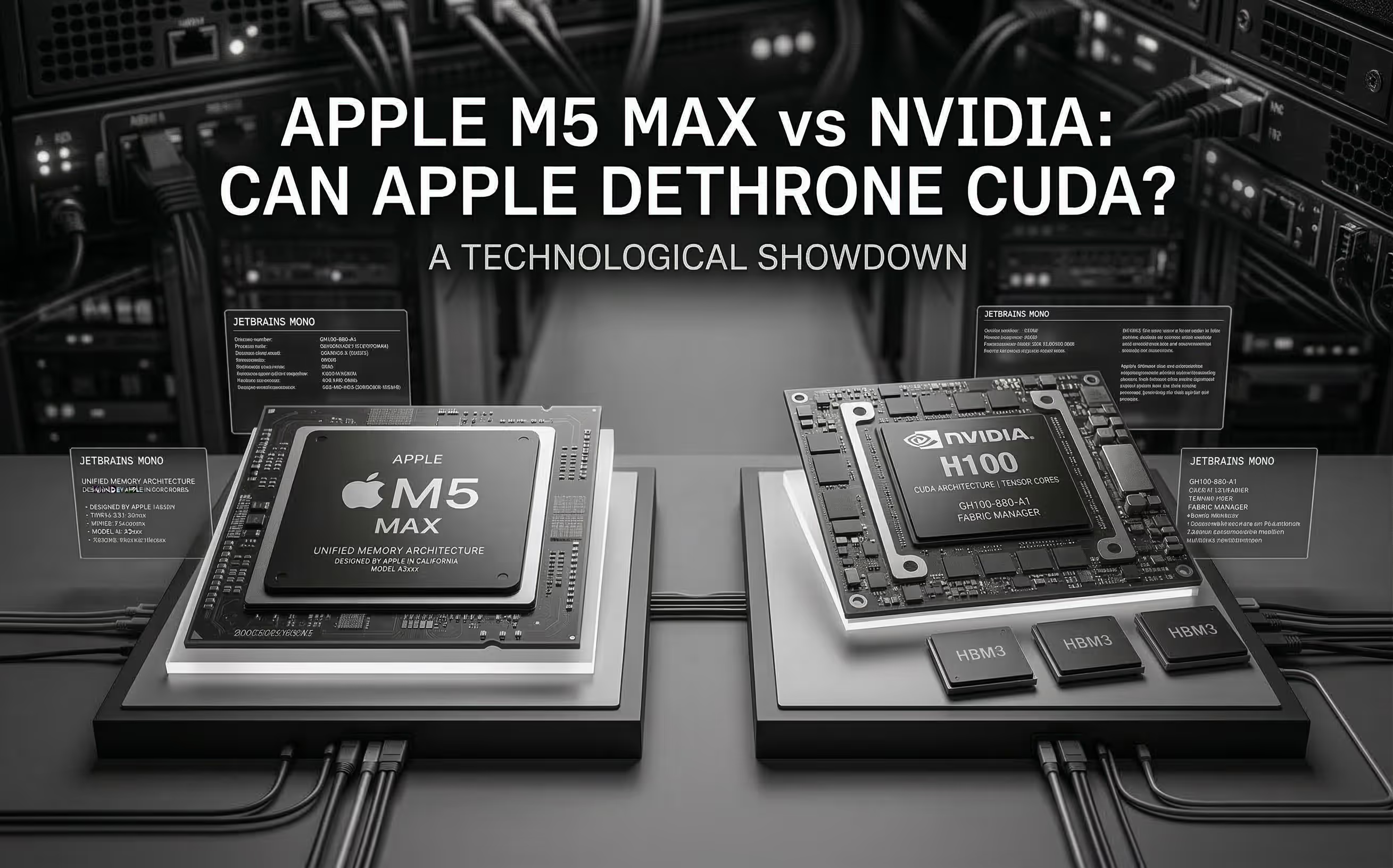
The M5 Max promises ~70 TFLOPS FP16 through dedicated Neural Accelerators and 128 GB unified memory at 614 GB/s. We analyze the architecture, benchmark Apple's claims, and compare head-to-head with NVIDIA for AI inference.
.jpg)
We pit the NVIDIA DGX Spark against the Mac Studio in a "Race to 1 Million Tokens." The results prove that in high-throughput agentic workflows, the most efficient machine is not the one with the lowest idle wattage—it's the one that finishes the job first.

