RTX 5090 vs RTX PRO 6000 Blackwell
Hundreds of RTX 5090 vs RTX PRO 6000 comparisons already exist, yet most rely on short benchmarks that ignore real production behavior. This article explains why sustained workloads, memory integrity, and long-term stability matter more than peak scores.
Why This Comparison Exists
Hundreds of GPU comparisons already exist. Most of them look the same. They line up specs, run short benchmarks, and rank GPUs by peak performance. Those articles answer a narrow question. Which GPU is faster for a few minutes under ideal conditions.
That question is not very useful for real ai systems or production workloads. AI training, fine tuning, and large scale rendering do not run for minutes. They run for hours or days. They stress gpu memory, power draw, driver stability, and thermal behavior over time.
We wrote this comparison because most benchmarking articles miss that reality. They measure speed. They do not measure endurance.
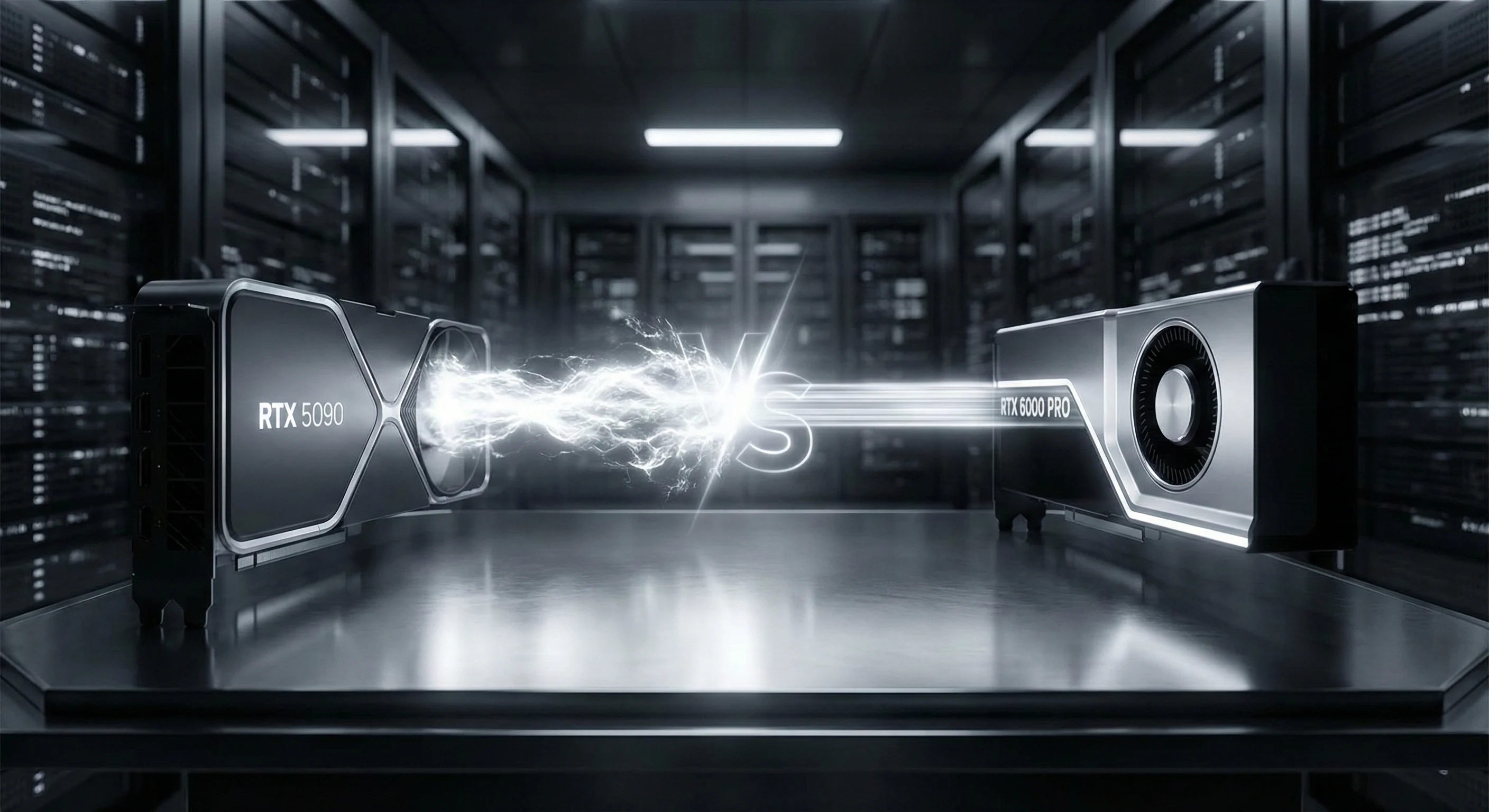
This article compares the RTX 5090 vs RTX PRO 6000 Blackwell from an operational perspective. It focuses on sustained gpu workloads, long running ai training, large neural networks, and continuous 3d rendering jobs. The goal is not to crown a winner. The goal is to explain why these two GPUs command very different prices despite sharing the same Blackwell architecture.
Blackwell Architecture
Same Generation, Different Intent
Both GPUs use NVIDIA's Blackwell GPU architecture. This architecture powers modern ai development, large datasets, and modern compute across data centers and workstations. Sharing an architecture does not mean sharing the same design goals. Blackwell improves on Ada Lovelace in several areas. It delivers better scheduling, higher Tensor Core throughput, a larger cache hierarchy, and a more advanced memory subsystem. A major addition is the AI Management Processor. It improves coordination during complex ai workloads. Fifth generation Tensor Cores also increase efficiency for matrix heavy operations. These improvements benefit all Blackwell GPUs. The difference is how long each GPU can sustain them. The RTX 5090 targets maximum peak performance during short, interactive tasks. The RTX PRO 6000 Blackwell targets stable performance during continuous workloads that run for hours or days. [CITATION: NVIDIA Blackwell GPU Architecture Whitepaper]
Core Compute and Sustained Scheduling
Rather than listing raw specifications, the table below summarizes how each GPU behaves once workloads extend beyond short benchmark windows.
| Category | RTX 5090 | RTX PRO 6000 Blackwell |
|---|---|---|
| CUDA Cores | 21,760 | 24,064 |
| Clock Strategy | Aggressive boost-focused behavior | Conservative steady-state tuning |
| Peak Throughput | Higher short-duration performance | Lower peak, higher consistency |
| Sustained Performance | Greater variance once thermally saturated | Stable after reaching thermal equilibrium |
| Operational Focus | Interactive and burst workloads | Continuous, long-running workloads |
Key comparison points:
- CUDA cores: RTX 5090 (21,760) vs RTX PRO 6000 Blackwell (24,064)
- Clock strategy: aggressive boost (consumer) vs conservative steady-state tuning (workstation)
- Peak behavior: higher short-duration throughput vs lower peak with higher consistency
- Sustained behavior: greater variance over time vs stable once thermally saturated
In long-running AI training and 3D rendering, scheduler efficiency, power stability, and consistent clock behavior matter more than brief boosts. Consumer GPUs often show wider performance swings once temperatures stabilize. Workstation GPUs are tuned to reduce that variance to protect continuous workloads.
[CHART SPECIFICATION: Sustained Frequency Stability]
Memory Architecture
Why Memory Integrity Matters More Than Bandwidth
On paper, both GPUs look similar. They share a 512-bit GDDR7 interface and deliver 1,792 GB per second of memory bandwidth. In real production workloads, bandwidth is rarely the limiting factor. Memory integrity is. (For a deep dive on memory reliability in production, see ECC vs Non-ECC Memory and Silent Render Failures.)
| Category | RTX 5090 | RTX PRO 6000 Blackwell |
|---|---|---|
| VRAM Capacity | 32 GB GDDR7 | 96 GB GDDR7 |
| Memory Interface | 512-bit | 512-bit |
| Memory Bandwidth | 1,792 GB/s | 1,792 GB/s |
| ECC Support | On-die only | Always-on, system-level ECC |
| Error Handling | Silent errors possible | Single-bit correction, multi-bit detection |
| Best Fit | Short training runs and experimentation | Long-running AI training and production workloads |
Key comparison points:
- VRAM capacity: RTX 5090 (32 GB) vs RTX PRO 6000 Blackwell (96 GB)
- Memory bandwidth: both list 1,792 GB/s on a 512-bit GDDR7 interface
- ECC: on-die only vs always-on, system-level ECC
- Error handling: silent corruption risk vs single-bit correction and multi-bit detection
- Best fit: short runs and experimentation vs long-running, high-integrity workloads
The RTX 5090 memory subsystem works well for interactive workflows and short fine-tuning runs that fit within its memory limits. Under sustained pressure, general GPU reliability research shows that silent data errors can occur without crashing applications, leading to corrupted results.
The RTX PRO 6000 Blackwell prioritizes memory integrity. Its always-on ECC corrects single-bit errors automatically and flags multi-bit errors before corrupted data propagates. For AI training, this protects weights and gradients. For rendering, it protects geometry, textures, and cached assets.
Benchmarks rarely expose this difference because they do not run long enough for error probability to rise.
[CITATION: NVIDIA Research – Characterizing and Mitigating Soft Errors in GPU DRAM] [CITATION: NVIDIA Developer Forums – RTX PRO 6000 Blackwell ECC] [CHART SPECIFICATION: Error Probability vs Runtime]
AI Workloads
Peak TOPS vs Deterministic Training
The RTX 5090 delivers up to 3,352 ai tops using fifth generation Tensor Cores. This favors peak throughput in short ai training runs. This makes it well suited for ai powered inference, experimentation, and short training cycles. The RTX PRO 6000 Blackwell delivers up to 4,000 ai tops. It pairs this with ecc memory and enterprise gpu drivers. It pairs that computational power with ecc memory and enterprise stability. Research on silent data errors shows that a single bit flip can cause major accuracy loss in deep learning models. For long running ai training, consistency matters more than peak throughput. Teams can evaluate both GPUs in production with our AI Fine-Tuning Kit. ECC does not make each step faster. It reduces the risk of invalid convergence after many hours of compute. [CITATION: Silent Data Errors in Deep Learning Models] [CITATION: GPUHammer Study]
Rendering and Content Creation at Scale
This section is particularly relevant for teams in VFX & Virtual Production workflows.
The RTX 5090 performs extremely well in interactive workflows, previews, and short 3d rendering jobs. For application-specific GPU guidance, see our DaVinci Resolve Hardware Guide. Viewport performance and responsiveness benefit from aggressive boost behavior. The RTX PRO 6000 Blackwell is designed for overnight and multi day renders. It handles larger scenes, supports higher gpu memory usage, and maintains more consistent performance over time. Thermally, the RTX 5090 relies on ideal airflow and tuning to sustain peak clocks. The RTX PRO 6000 Blackwell is designed to operate at a steady thermal state during continuous load. Our Max-Q architecture analysis explains how thermal design shapes multi-GPU density. [CHART SPECIFICATION: Render Time Variance Under Sustained Load]
Media Engines and Production Pipelines
Video production pipelines benefit from parallel encode and decode capacity rather than raw shader performance.
| Category | RTX 5090 | RTX PRO 6000 Blackwell |
|---|---|---|
| NVENC Engines | 3 | 4 |
| NVDEC Engines | 2 | 4 |
| AV1 Encode / Decode | Supported | Supported |
| Parallel Stream Capacity | Moderate | High |
| Production Impact | Optimized for single or few streams | Optimized for multi-stream pipelines |
Key comparison points:
- NVENC: RTX 5090 (3) vs RTX PRO 6000 Blackwell (4)
- NVDEC: RTX 5090 (2) vs RTX PRO 6000 Blackwell (4)
- AV1 encode and decode: both supported
- Practical impact: higher parallel stream headroom on the workstation GPU
For multi-stream encoding, virtual production, and media-heavy workflows, the additional engines in the RTX PRO 6000 Blackwell enable higher sustained throughput. These advantages rarely appear in consumer benchmarks because they do not stress parallel media pipelines.
Driver Stack and Long Term Stability
The RTX 5090 supports game ready and studio drivers. Studio drivers are more conservative but still follow a consumer release cadence. The RTX PRO 6000 Blackwell uses enterprise gpu drivers. These drivers follow longer validation cycles and focus on stability for professional applications. This difference becomes more important months into production.
What Benchmarks Miss
Benchmarks answer one question well: peak GPU performance under short, controlled conditions.
They do not measure:
- Long-running GPU workloads
- Memory error accumulation
- Thermal steady-state behavior
- Clock variance over time
- Driver stability across weeks or months
This is why spec tables and short benchmarks fail to explain real production outcomes. They measure speed, not endurance.
Choosing the Right GPU for the Job
Choose the RTX 5090 if workloads are bursty and peak performance per dollar matters most. This includes interactive ai development, inference, previews, and short training runs. Choose the RTX PRO 6000 Blackwell if workloads run continuously and gpu memory integrity matters. This includes long running ai training, large neural networks, sustained gpu workloads, and multi day rendering jobs. Both GPUs deliver high compute performance. They are built for different operational realities.
Summary: What This Comparison Actually Shows
The RTX 5090 vs RTX PRO 6000 Blackwell comparison is not about raw speed. It is about how gpu performance behaves over time. Consumer GPUs prioritize peak compute performance for short workloads. Workstation GPUs prioritize stability, gpu memory integrity, and sustained gpu workloads. For ai training stability, ecc memory and enterprise gpu drivers reduce risk during long running jobs. For rendering workstation gpu use cases, consistent clocks and large gpu memory pools matter more than brief boosts. Benchmarks rarely capture these differences. Operational reality does.
Where Skorppio Fits
For teams evaluating workstation gpu platforms for ai training or rendering, Skorppio provides short term access to RTX PRO 6000 Blackwell workstations and multi-GPU configurations. This allows validation of sustained gpu workloads before large capital purchases. See our Rent vs Buy Decision Framework for a structured approach to this decision.
Data Availability and Transparency
As of January 2026, independent long duration testing data for these GPUs remains limited. Architectural specifications and short duration stress tests exist. However, controlled 24 to 72 hour ai training studies do not. Where long running behavior is discussed, conclusions rely on documented architecture and established ecc research. This approach preserves technical accuracy without overstating what current data can support.
Ready to evaluate? Create a business account to access pricing and availability, or contact our team for workload-specific guidance.
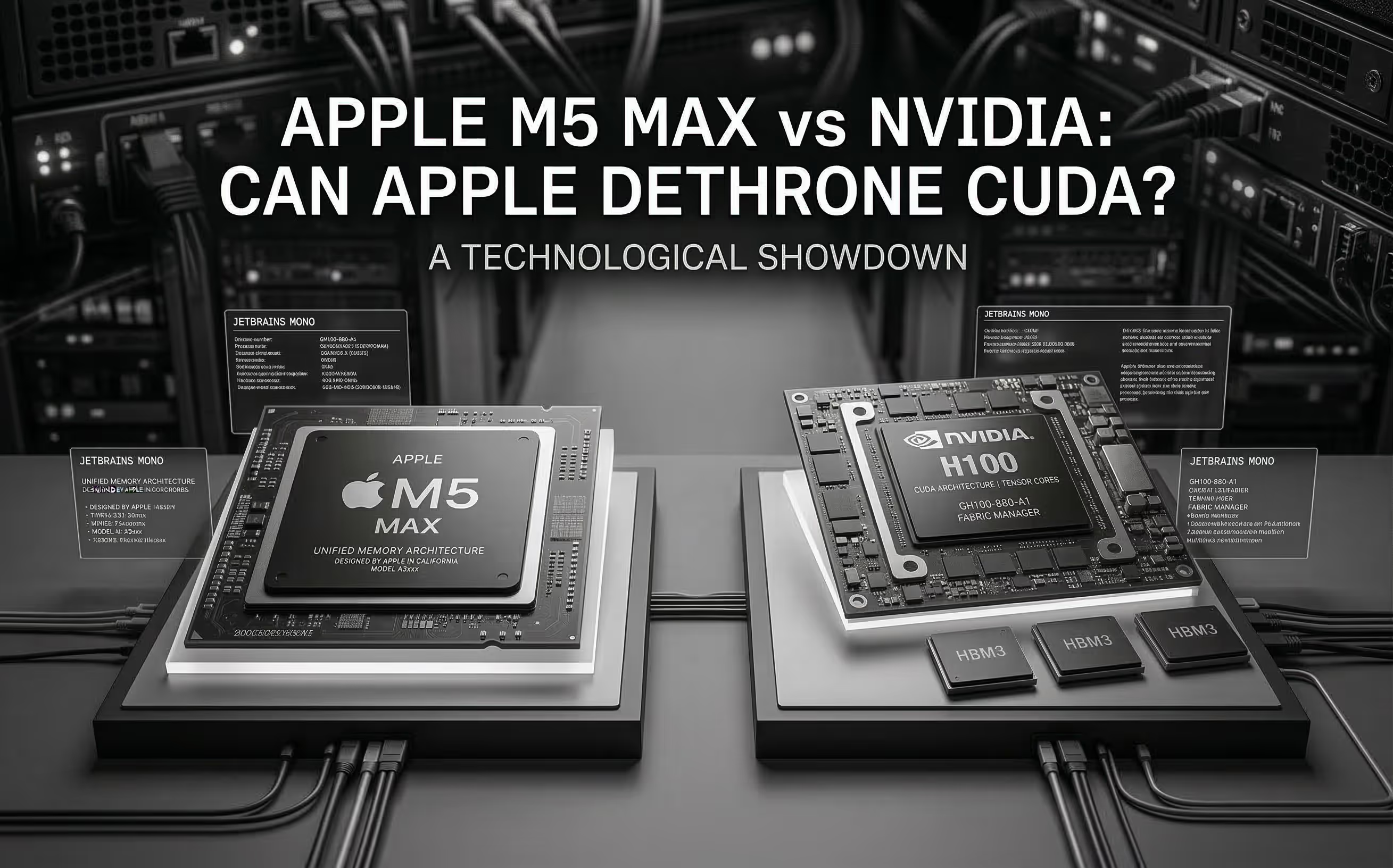
The M5 Max promises ~70 TFLOPS FP16 through dedicated Neural Accelerators and 128 GB unified memory at 614 GB/s. We analyze the architecture, benchmark Apple's claims, and compare head-to-head with NVIDIA for AI inference.
Cloud GPU pricing looks aggressive on paper. But hourly rates hide commitment traps, counterparty risk, and debt-funded subsidies that change the math entirely. Here is what your finance team should model before signing.